







see all jobs
Elevate taps a wide range of critical industry trends


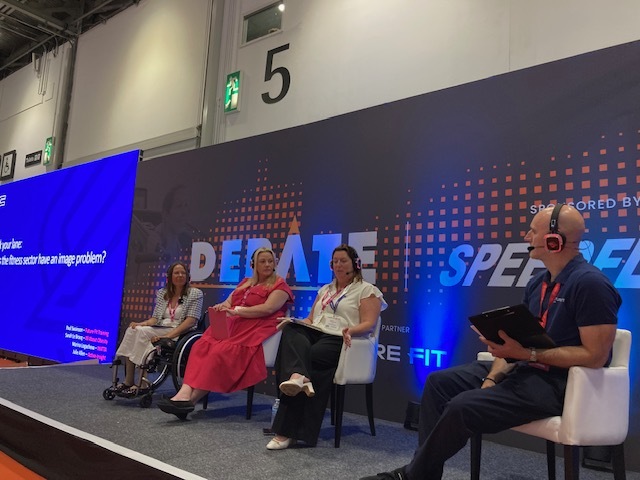
Celebrating its 10th anniversary, Elevate has had its busiest show to date, with almost 200 exhibitors, 115 seminars and 200 speakers over two days, with numbers understood to be up by ten per cent over the two days.
Highlights included a Partnership with Intelligent Health to bring in a Beat the Streets trail, with boxes placed on the stands of legacy exhibitors who have been with the Event since the beginning.
Another high point was a live Workout led by 1980s tv Fitness legend, Mr Motivator, who is working with Innerva, around engaging older People with Exercise. This was clearly a topic which resonated with the audience, as there were no spare seats for Thursday’s panel discussion on the importance of Training'>Strength training for older people on the Debate stage.
Talking points on panels included Technology, AI, gamification, longevity, diversity and Inclusion, as well as the underlying pillars of health – breathing, sleeping, nutrition and Recovery.
Here are some of HCM’s key takeaways.
Opportunities to widen our welcome
The disability market is being underserved, with opportunities for the sector.
Including invisible disabilities, one in four people have a disability in the UK and this cohort represents an annual spending power of £446 billion. Of the 49 per cent who are active only half of those feel welcome where they train.
Disability consultant, Marina Logacheva, who is Researching and campaigning on the subject told HCM that the industry is taking too long to shift the dial on this issue. As a wheelchair user she has been told by multiple fitness professionals that they won’t work with her because they don’t know how to.
She also has to pay for services at her gym that she is unable to access – for example the Swimming pool is inaccessible because there is no hoist – but the gym will not give her a discount.
This is not good enough for an industry which talks about lowering barriers, being inclusive and supporting the NHS. There is the continual narrative in the industry that people who don’t go to gyms have the wrong perception of our facilities, but do they?
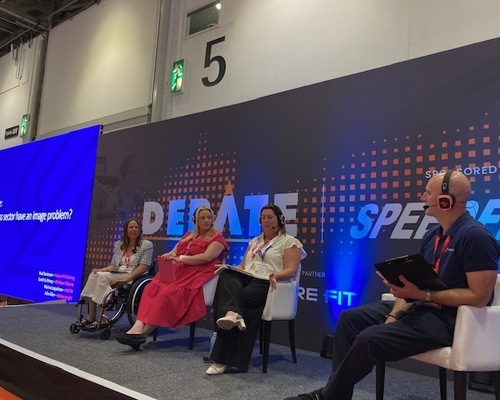
In a panel discussion chaired by Future Fit’s Paul Swainson, entitled Does the industry have an image problem, Logacheva and fellow panelists Sarah LeBrocq, founder of All About Obesity and managing director of Active Insight, Julie Allen, agreed that being more inclusive starts with images used in Marketing. The people who aren’t coming to facilities need to see people like themselves represented in order to feel they might have a place there.
“Creating a feeling of belonging starts with the ad. If you don’t see yourself then you feel like you don’t belong there,” said Logacheva. “People with disabilities are only on 2 per cent of ads on Social media.”
Allen shared a compelling story from a focus group of a man who suffered a stroke which motivated a lifestyle change. After being prescribed GLP-1 medication by his GP and losing weight, he said he felt able to lift the heaviest weight – the door handle of the Leisure centre.
“Confidence is one of the top five barriers among people who don’t go to gyms. They feel a sense that the gym is not the place for them,” says Allen. “The industry is still not doing enough to look through the lens of the consumer.”
Triathlete, distance runner and obesity campaigner, LeBrocq, expressed frustration about being patronised by gym staff and having assumptions made that she has joined the gym to lose weight. “Treat the individual, ask questions and don’t make assumptions based on appearance,” she said.
Logacheva has published a Report on Creating Welcoming Fitness Environments based on her research trip to Australia which can be downloaded for free at disabilityinsport.com/report
Mental health – great progress and more work to do
A panel discussion hosted by UK Active’s director of Membership and sector Development, Marianne Boyle, celebrated the journey that the fitness sector has been on with mental health. Ten years ago it was barely spoken about, now it’s widely observed that people use facilities to improve their state of mind as much as their physical health.
There has been a huge amount of progress and yet there's still a way to go – only 16 per cent of people living with mental health conditions are meeting WHO activity guidelines. Women, younger adults and those in lower socio-economic groups are the most likely to be losing out. “There is still a significant gap between what we know works and what people are able to access in our facilities,” said Boyle.
Panelists included psychotherapist, Charlotte Braithwaite; Swim England’s head of public affairs, Philip Brownlie; founder of Together We Lift, Liam Baker and Sam Perks physical activity Operations manager at mental health charity, Mind.
Key takeaways from the panel were the need to have some upskilling of the sector’s workforce so that fitness professionals are comfortable having big conversations while staying in lane.
Perks said that fitness instructors have told him that clients have spoken to them about having suicidal feelings, which is a lot to take on board. The panel stressed that instructors don’t need to solve the problem, they need to be empathetic, present with the individual and know where to signpost.
Braithwaite spoke about the importance of creating psychological Safety in gyms and this can only be done by humans. “Gyms can be a confronting environment,” she said. “They’re full of mirrors and metal and people who look like they know what they’re doing. Simply interacting with weights isn’t Wellness. You need people and you need to spell out what to expect and provide human touchpoints to make everyone feel safe.”
She also spoke about neuroaesthetics – providing environments where nervous systems feel safe – which HCM has identified as a trend.
Trauma – more common than you think
Another panel discussed the creation of trauma-informed fitness environments, with Akusile Makawa from Loughborough University; Fiona Roberts, founder of The Movement Charity and Kim Grey, founder of Sattva Trauma Informed Education, which offers a CIMSPA-accredited training course to empower fitness professionals to work this cohort.
Trauma might sound niche, but it’s not. Shelving perceptions of what a person living with trauma looks like is important – it’s very likely to be that high-achieving CEO who appears to have life nailed.
Roberts said that 70 per cent of people have experienced trauma, 25 per cent of women have experienced domestic violence and 20 per cent have experienced some form of child abuse.
“There will be people in your clubs and classes who've experienced trauma,” she says. “And if not it’s because they’re not getting through the barriers to your facility.”
Human connection, providing touchpoints, relationship building and empathy are the foundations of addressing this issue.
Roberts says that setting the scene at the start of the class of what to expect creates safety and predictability. She also says it’s important to give the individual an element of choice as often they’ve had choices taken away – this could be leaving the class early with no questions asked and no offence taken. “Tell them that everything is optional, that they are in charge of their own bodies and what they do in the class,” she says.
The Movement Charity takes exercise into the Community, including women’s refuges and Roberts talked through some of her experiences, including leaving mats by the door, for people to choose where they put them. She also provided a great example of how an empathetic instructor can build confidence.
“Initially people tend to stay by the door and as far away from me as possible because I present the threat,” she said. “But in time they move closer to me and put me between them and the door because I come to represent safety.”
Grey highlighted a major no-no – asking people in front of the class whether they have any injuries or issues. This might sound basic, yet it still happens.
She also highlighted that trauma gets stored in different parts of the body – for example hips, which can lead to some exercises being triggering. Subtly offering alternatives can be a way to navigate this.
Another important takeaway – check before the start of each class if people are happy with being adjusted. A better way of allowing people to respond than a show of hands is to give them a card or a coin which they can flip according to their preference, which might change from day to day.
Exercise addiction – too much of a good thing
Exercise is medicine, but even medicine can have negative side effects for some people. HCM attended a couple of panel discussions which talked about this important issue.
Exercise addiction is when the individual feels dependent on it and an uncontrollable compulsion to exercise, which gets in the way of other areas of their life, for example their work or relationships.
It affects 8 per cent of general exercisers, 9 per cent of fitness professionals and is 3.5 times more likely in those experiencing eating disorders.
People with high intelligence, a tendency towards perfectionism and possibly some form of neurodivergence are most vulnerable to over-exercise.
This is the same cohort that needs to be careful with tracking data. As wearables and data continue to be more deeply embedded in the industry, it’s very important to acknowledge that not everyone will benefit from using them. For some people, the data will start to control them.
Exercise psychologist, Dr Paula Watson, spoke about her work with clients living with exercise addiction. Often these are people who take sports seriously and their identity becomes caught up with it. Much of her work with clients is around developing self-love and self-compassion.
“There are two distorted beliefs associated with exercise addiction,” she says. “The individual feels that if they’re not strict with their training they'll lose control, for example get fat, or not get big enough, or not be able to cope with their emotions. And if that happens, they’re not good enough.
“The language unintentionally used in fitness Culture can fuel these distorted beliefs,” she says. “For example, 'you’re a machine'”.
Dr George Mycock, founder of MyoMinds, shared his journey with over-exercise and shared some valuable advice: "More is not always better – don’t celebrate exhaustion, stress the need for rest and recovery when working with clients. Avoid talking about using exercise as a way of earning food. And avoid linking self-identity with exercise – talk to clients about the other areas of their life as well."
The fundaments of good health and an opportunity for coaches
Thomas Hague, The Breath Coach, has worked in elite sport, including with British Sailing, GB Boxing and British Triathlon, as well as individuals struggling with anxiety. He said that breath is the missing performance skill and wants to normalise breath assessments and breathwork in the industry.
“Super simple changes to breath can make a huge difference to performance,” he said. “Breath underpins all the work an athlete or individuals do. The quickest way to downregulate the nervous system is to change the cadence of the breath, it improves the ability to handle pressure, speeds up recovery, improves sleep and emotional regulation, relaxes muscles and can bring about a 30 per cent increase in range of motion. However, most of us completely ignore the thing that keeps us alive.”
Hague says that a few minutes of deep breathing at end of workout would clear the stress of the workout and set the client up for better recovery.
Fitness professionals who are trained in breathwork could help clients to overcome the common negative breathing patterns – mouth breathing, fast respiratory rate (we should breathe 5.5 times a minute), upper chest breathing, poor lower rib mobility (they should expand by 1 - 2.5 cm on an in-breath), weak breathing muscles and poor breathing mechanics. Building carbon dioxide tolerance can help the delivery of oxygen to muscles.
The Sleep Geek, James Wilson, said there is also the opportunity for fitness professionals to be the experts on sleep – both the number one recovery tool and a growing pain point, with people suffering from poor sleep, insomnia and the quest for the perfect night's sleep.
He cautioned about reliance on sleep trackers, saying they're not accurate and that optimisation culture makes us doubt ourselves. If people are told they are sleeping badly, they are likely to have a worse night's sleep.
Some surprising facts raised by Wilson were that we inherit our sleep patterns. Some people are lucky, others less so. Some people can sleep soundly after drinking a cup of tea before bed, others can’t tolerate any caffeine. Emotional and physical security are crucial for sleep. You sleep better if you sleep next to someone you love and this also works the other way.
Next steps
As the industry looks to broaden its reach to cater for new audiences, work more closely with the health service and attract Investment, it was great to see such a broad conference programme. While there is still some way to go to become fully inclusive, it’s heartening to see that the conversations are underway and a growing awareness of the changes the industry needs to make. Hopefully all attendees went back to work brimming with inspiration and with some ideas to implement.
More News







- News by sector (all)
- All news
- Fitness
- Personal trainer
- Sport
- Spa
- Swimming
- Hospitality
- Entertainment & Gaming
- Commercial Leisure
- Property
- Architecture
- Design
- Tourism
- Travel
- Attractions
- Theme & Water Parks
- Arts & Culture
- Heritage & Museums
- Parks & Countryside
- Sales & Marketing
- Public Sector
- Training
- People
- Executive
- Apprenticeships
- Suppliers