







see all jobs
New GWI study unveils global wellness market leaders: US, China and Germany



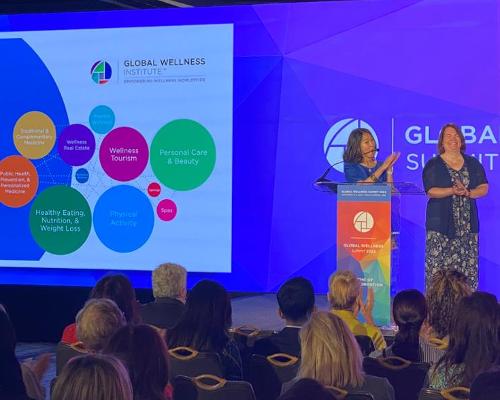
The US, China, Germany, Japan and the UK have been identified as the world’s five largest wellness markets in new research released today by the Global Wellness Institute (GWI).
Called The Global Wellness Economy: Country Rankings, the new study provides market size, rankings, analysis and per capita wellness spending for 145 nations.
Findings show the US remains the undisputed goliath in wellness spending, with an annual market worth US$1.8 trillion, and ranking first in nine of the 11 wellness sectors measured by the GWI.
Almost all the top 25 wellness markets have seen strong growth since the pandemic, with the UK, the Netherlands, the US, Mexico, Canada and Australia as standouts, surpassing their pre-pandemic market sizes by 120 per cent or more.
Globally, the wellness economy drives 5.6 per cent of total GDP, which, according to the GWI, means one in every 20 “dollars” spent by consumers worldwide is on wellness.
To put this wellness spending in context, the research finds that annual, global per capita spending on wellness (US$706) is on par with consumer out-of-pocket spending on healthcare (US$711).
At the regional level, per capita wellness spending is higher than consumer out-of-pocket spending on healthcare across every region except North America. And wellness spending per capita is higher than spending on clothing/shoes (US$289) and hotels/restaurants (US$475) all across the world (Euromonitor data).
In countries like Switzerland, Iceland and the US, people spend far more: on average, over US$5,300 a year on wellness.
“For countries interested in growing their wellness economy, it’s crucial to know where they stand in this massive global industry,” said Ophelia Yeung and Katherine Johnston, GWI senior research fellows.
“It’s also important to see how different countries’ wellness markets have responded to the impacts of the pandemic.”
The report is a sister publication to GWI’s recent 2023 Global Wellness Economy Monitor, a complete global update on all 11 wellness sectors.
Top 25 national wellness markets
Numbers refer to market size and annual growth rate 2020-2022:
1) US – US$1.8 trillion – 14 per cent
2) China – US$790 billion – 8.9 per cent3) Germany – US$269 billion – 16.8 per cent
4) Japan – US$241 billion – minus 3.9 per cent5) UK – US$224 billion – 19.4 per cent
6) France – US$172 billion – 11.6 per cent7) India – US$132.5 billion – 16.5 per cent
8) Canada – US$128 billion – 13.5 per cent9) S. Korea – US$113 billion – 9.4 per cent
10) Italy – US$112 billion – 7.9 per cent11) Australia – US$110 billion – 12.9 per cent
12) Brazil – US$96 billion – 18.2 per cent13) Russia – US$94.5 billion – 13.2 per cent
14) Spain – US$83 billion – 12.4 per cent15) Mexico – US$74 billion – 25.2 per cent
16) Netherlands – US$50 billion – 12.1 per cent17) Switzerland – US$50 billion – 14.5 per cent
18) Indonesia – US$49 billion – 5.9 per cent19) Turkey – US$45 billion – 14 per cent
20) Taiwan – US$43 billion – 5.1 per cent21) Austria – US$42 billion – 13.9 per cent
22) Philippines – US$41 billion – 8.9 per cent23) Poland – US$39 billion – 11.1 per cent
24) Thailand – US$35 billion – 8.5 per cent25) Sweden – US$30 billion – 7.5 per cent
The top 10 largest markets represent 70 per cent of the global wellness economy, while the top 25 represent 86 per cent.
The GWI found that the vast majority of the 25 largest wellness markets have seen robust recent growth. Comparing market sizes in 2019 vs. 2022, 22 of 25 countries (except Thailand, Japan and Brazil) are now larger than pre-pandemic, as measured in US dollars.
But the GWI says it’s important to note that currency depreciation impacts data for countries like Japan, Brazil and some eurozone countries like Germany, France and Italy. For instance, the Japanese yen fell by 19.8 per cent against the US dollar in 2022, so if it looks like its wellness market shrank by 3.9 per cent annually from 2020 to 2022 in dollars, it actually grew 6.6 per cent each year when measured in yen.
Wellness spending per capita: top 12 countries
1) Seychelles – US$8,097
2) Switzerland – US$5,7373) Iceland – US$5,523
4) Aruba – US$5,3615) US – US$5,321
6) Austria – US$4,6837) Australia – US$4,218
8) Norway – US$4,1979) Denmark – US$3,846
10) New Zealand – US$3,68911) UK – US$3,342
12)Canada – US$3,287
The GWI discovered that spending on wellness is highest in wealthy countries that also rank in the top 25 for GDP per capita, including Switzerland, Iceland, the US, Austria and Australia.
Those countries have seen significant recent growth in wellness spending (per capita): in the US that spend has risen US$1,636 – and in Switzerland US$1,365 – between 2020 and 2022.
While it may be surprising to see small countries like the Seychelles and Aruba so high on this list (the Maldives and the Bahamas also rank in the top 25), the GWI says it’s because these islands are major high-end wellness tourism destinations, with a large portion (50-90 per cent) of their wellness spending coming from inbound wellness tourists rather than locals.
The GWI describes the impact of the wellness market – heavily dominated by inbound wellness tourism – on these countries’ economies as “staggering”. In the Seychelles, the wellness market accounts for 42 per cent of the total economy, while in the Maldives that number is 22.6 per cent.
The ratio of how much the wellness economy contributes to GDP is highest in North America (6.9 per cent) and Europe (5.8 per cent) – and lowest in the Middle East-North Africa region, at 3.3 per cent.
North America and Europe’s wellness markets have been growing faster than the overall economy. Among the top 25 wellness markets, some of the countries where wellness makes up a bigger percentage of GDP are the Philippines (10.1 per cent), Austria (9 per cent), the UK (7.3 per cent), the US (7 per cent) and South Korea (6.8 per cent).

More News










- News by sector (all)
- All news
- Fitness
- Personal trainer
- Sport
- Spa
- Swimming
- Hospitality
- Entertainment & Gaming
- Commercial Leisure
- Property
- Architecture
- Design
- Tourism
- Travel
- Attractions
- Theme & Water Parks
- Arts & Culture
- Heritage & Museums
- Parks & Countryside
- Sales & Marketing
- Public Sector
- Training
- People
- Executive
- Apprenticeships
- Suppliers